iPhone Screen Replacement Sydney — Cost, Time & Warranty Guide
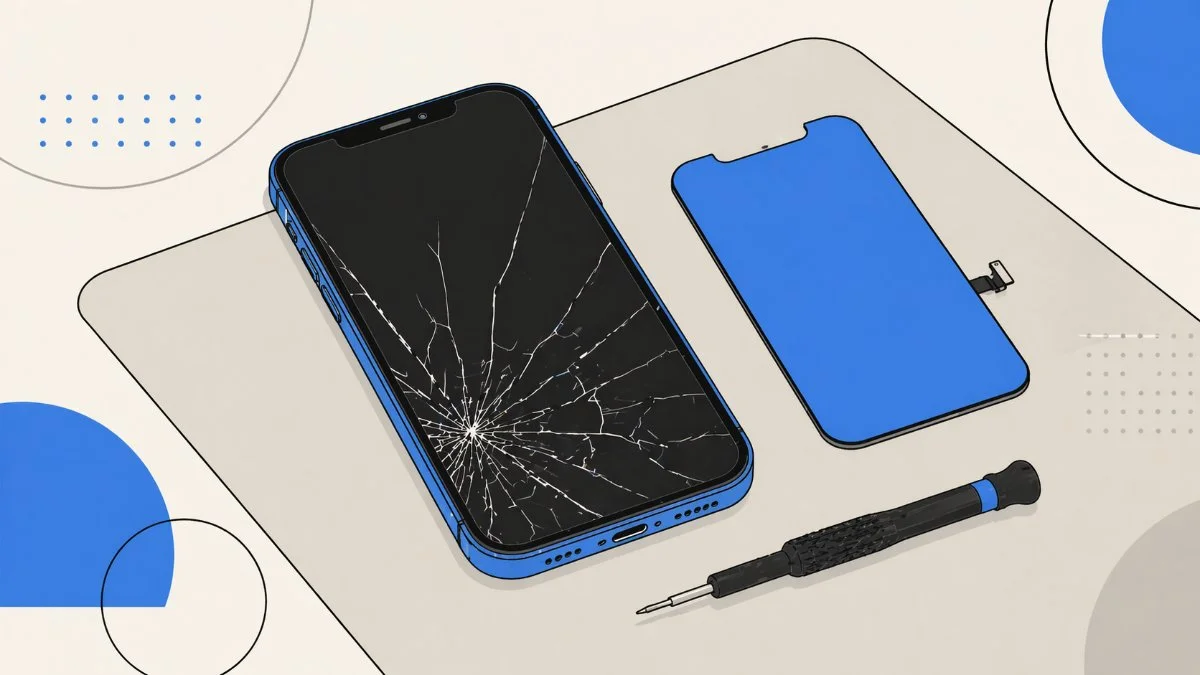
A cracked iPhone screen is one of the most common — and most stressful — phone problems in Sydney. The hard part is not the repair itself. It is working out which quote is fair, which shop is safe, and how long you are going to be without your phone.
We run a repair shop in Auburn and every week we see customers who paid too much, paid too little, or lost their True Tone and Face ID because of a bad part. This guide lays out what a realistic Sydney iPhone screen replacement actually looks like in 2026 — real prices, real timings, and what to look out for before you hand over your phone.
How much does iPhone screen replacement cost in Sydney?
At Lux Phone Auburn we keep this simple: iPhone screen replacement is $99 flat for every model, from iPhone 7 all the way through iPhone 16 Pro Max. There is no per-model price ladder and no surprise upsell — the price you see is the price you pay.
| iPhone model | Lux Phone Auburn price |
|---|---|
| iPhone 8 / 8 Plus / SE (2nd/3rd gen) | $99 flat |
| iPhone X / XS / XR / 11 | $99 flat |
| iPhone 12 / 12 Pro / 13 / 13 Pro | $99 flat |
| iPhone 14 / 14 Plus / 14 Pro | $99 flat |
| iPhone 15 / 16 / Pro / Pro Max | $99 flat |
A flat $99 covers all models — see our iPhone screen replacement Sydney page for the full breakdown and to book. Independent repair like ours is typically much cheaper than out-of-warranty Apple service. Be cautious of any shop quoting a price that seems too good to be true — that usually means a very cheap aftermarket screen, which can cause ghost touch, dim backlight or loss of True Tone within a few weeks.
How long does the repair take?
At Lux Phone Auburn a screen swap is a same-day job, usually completed in 30 to 60 minutes while you wait, assuming the part is in stock. Newer OLED models can take a little longer because the display has to be re-paired and calibrated to restore True Tone and auto-brightness.
If you go through Apple directly, the turnaround is generally slower because your iPhone may be sent away to a repair centre, and walk-in appointments often book out well in advance.
OEM vs aftermarket screens — what is actually inside the box?
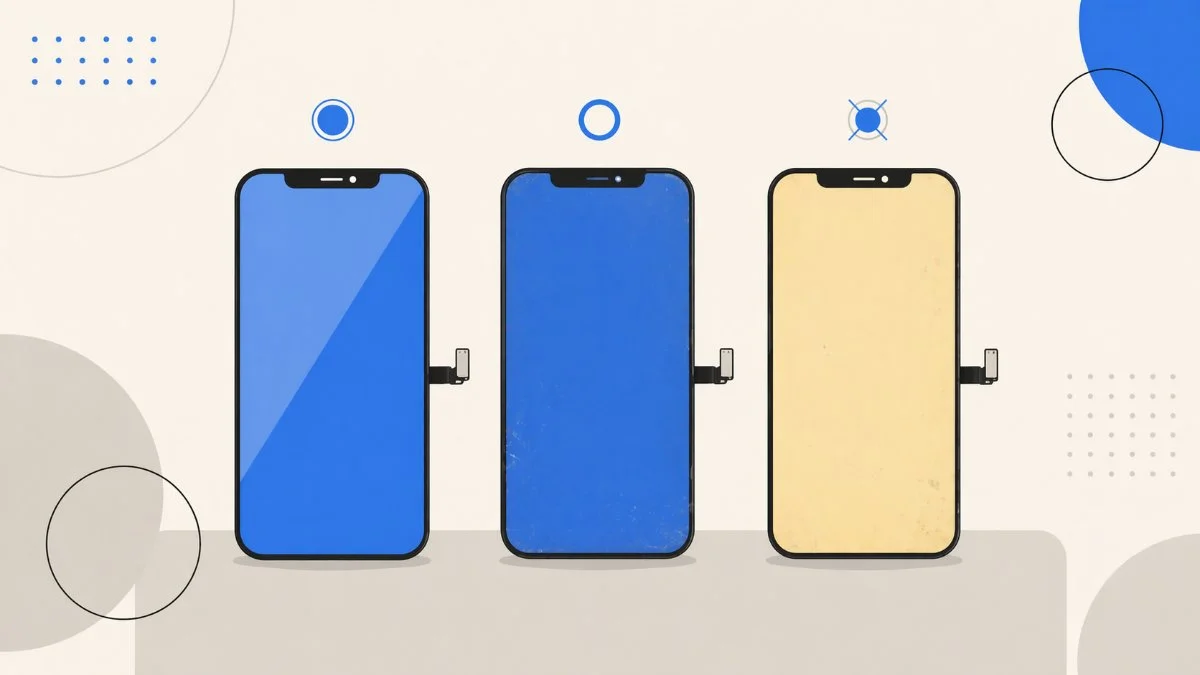
When a Sydney shop quotes you a price, what you are really paying for is the parts grade. There are three tiers you will encounter:
1. Refurbished OEM (Apple original, reconditioned)
The original Apple display pulled from another iPhone and refurbished with a new glass top. Best colour accuracy, full True Tone, full Face ID. Highest cost. This is what Apple-authorised service providers use.
2. High-grade aftermarket (soft OLED / incell)
Made by specialist manufacturers (often in China) with a quality control process close to Apple's spec. These restore True Tone on most iPhone models and hold up for years. Used by the majority of established independent Sydney shops.
3. Budget aftermarket (hard OLED / cheap incell)
The cheapest screens you can buy wholesale. Touch response and brightness can be noticeably worse. Often come with compatibility warnings about brightness or Face ID. Almost always the reason a too-cheap back-alley screen fix goes wrong.
What should a fair warranty look like?
A reputable Sydney iPhone repair shop should give you a written warranty on both the screen and the labour. At Lux Phone Auburn every screen comes with a 6-month warranty on parts and workmanship — and a verbal-only or very short warranty from any shop is a red flag.
The warranty should cover defects in the screen itself — dead pixels, touch failure, unresponsive areas, backlight issues. It does not cover post-repair physical or water damage: if you drop it again and crack the new screen, that is your responsibility.
Will a third-party repair void my Apple warranty?
If your iPhone is still inside its original Apple warranty or AppleCare, a third-party screen replacement voids coverage on the display assembly and anything connected to it. Coverage on unrelated hardware — the rear camera, the battery, the logic board — usually stays intact, but Apple reserves the right to refuse any repair if they see non-Apple parts inside.
If your iPhone is out of warranty, which most cracked-screen iPhones are, you have nothing to lose. Third-party is the obvious choice on price alone.
Red flags when choosing a Sydney repairer
- No physical shopfront — only a phone number or a Gumtree ad.
- Price quoted is far below the local market.
- "Cash only, no receipt" policy.
- No written warranty, or verbal warranty only.
- No Google reviews, or fewer than 10 reviews after years of trading.
- Cannot tell you which grade of screen they are using.
- Refuses to show you the replacement part before installing it.
A proper Sydney repair shop will happily answer every one of those questions in 30 seconds. If they dodge, walk out.
Where to get your iPhone screen replaced in Sydney
Most Sydney customers have three realistic options in 2026:
- Apple Store / authorised service provider — highest cost, longest wait, but uses genuine Apple parts. Sensible if your iPhone is still under AppleCare.
- Established independent shops in Auburn, Parramatta, CBD, Chatswood and Bondi Junction — affordable pricing, faster turnaround, quality aftermarket parts with a written warranty.
- Budget pop-up repairers — cheapest on paper, but with real risk of part quality issues. Fine for a disposable phone, risky for anything you plan to keep for another year or more.
We run option 2 — Lux Phone in Auburn. See our full iPhone screen replacement Sydney service page for everything that is included. Walk-ins welcome Monday to Saturday, most screen repairs done in 30 to 60 minutes, 6 months warranty on every screen we fit. Same-day service on every iPhone model from iPhone 7 to iPhone 16 Pro Max.
iPhone screen replacement cost by model — what you would pay elsewhere
While Lux Phone Auburn charges a flat $99 for any iPhone screen, most Sydney shops price by model, and the gap between an iPhone 8 and an iPhone 16 Pro Max screen can be large. This is because Apple's newer OLED and ProMotion displays are far more expensive parts. Here is a realistic picture of what model-by-model iPhone screen replacement costs look like across Sydney in 2026, so you can judge whether a quote is fair.
| iPhone model | Typical Sydney range | Lux Phone Auburn |
|---|---|---|
| iPhone 7 / 8 / SE | $89 – $149 | $99 flat |
| iPhone X / XS / XR / 11 | $129 – $229 | $99 flat |
| iPhone 12 / 13 series | $169 – $329 | $99 flat |
| iPhone 14 series | $229 – $399 | $99 flat |
| iPhone 15 series | $279 – $449 | $99 flat |
| iPhone 16 / 16 Pro Max | $329 – $549 | $99 flat |
The wide ranges above reflect the difference between budget pop-up repairers (bottom of the range, lowest-grade screens) and Apple-authorised service (top of the range, genuine parts). A flat $99 for any iPhone screen is unusually transparent for the Sydney market — most customers comparing quotes find independent Auburn pricing well below CBD and Eastern Suburbs shops for the same repair quality.
Will Face ID and True Tone still work after a screen replacement?
This is the question we get asked most often, and it matters more on newer iPhones. Here is the honest answer for each:
Face ID
Face ID does not live in the screen itself — the dot projector and infrared camera sit in the top notch or Dynamic Island. A proper iPhone screen replacement transfers the original Face ID flex cable from your old screen to the new one. Done correctly, Face ID continues to work exactly as before. The only time Face ID breaks during a screen repair is when a careless technician damages or fails to transfer that flex cable — which is why you should always ask the shop to test Face ID in front of you before you pay.
True Tone
True Tone is paired to the original display's serial number. On iPhone 11 and newer, fitting a non-genuine screen can disable True Tone unless the shop uses a programming tool to copy the calibration across, or fits a refurbished OEM screen that retains it. At Lux Phone we tell you upfront whether True Tone will be preserved for your specific model and screen grade. Losing True Tone does not affect the screen working — brightness, colour and touch all function normally — it only turns off the automatic warm/cool colour shift.
What does the iPhone screen replacement process actually look like?
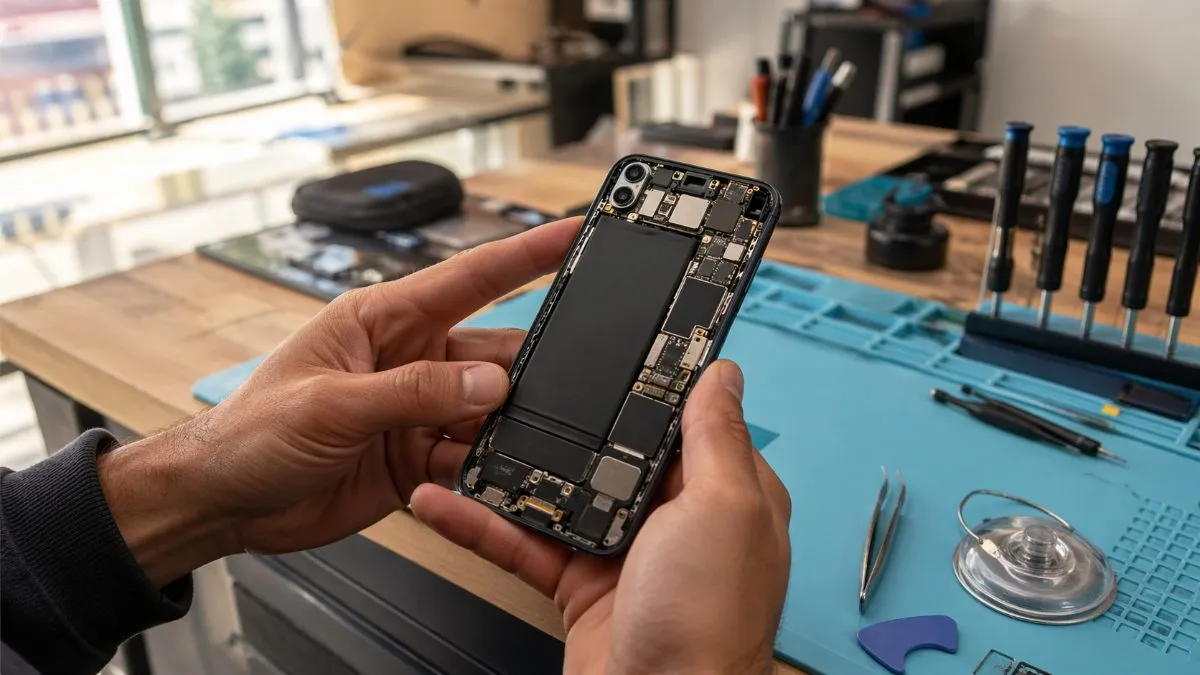
If you have never watched a screen replacement, here is what happens in the 30 to 60 minutes you are waiting at the shop:
- Power down and heat — the technician powers off your iPhone and applies gentle, controlled heat around the edges to soften the waterproof adhesive holding the screen down.
- Open and disconnect — the screen is carefully lifted, and the internal connectors (battery, display flex, Face ID flex, front camera) are disconnected. The battery is always disconnected first for safety.
- Transfer components — the Face ID flex, front camera, earpiece speaker and proximity sensor are transferred from your old screen to the new one. This step is what preserves Face ID.
- Fit new screen — the new screen is connected and tested before sealing, so any defect is caught early.
- Fresh adhesive and seal — new waterproof adhesive is applied around the frame to restore the original water resistance rating as closely as possible.
- Full function test — touch across the entire screen, Face ID, True Tone, brightness, cameras and speakers are all tested in front of you before you pay.
A shop that rushes this — skips the component transfer, reuses old adhesive, or doesn't test in front of you — is where Face ID failures and water-resistance loss come from. The extra 10 minutes of careful work is the difference between a repair that lasts years and one that fails in weeks.
Cracked glass vs damaged display — do you always need a full screen?
Not every cracked iPhone needs a full screen replacement, and an honest Sydney shop will tell you which situation you are in:
- Cracked outer glass, display works perfectly — the image is clear, touch works everywhere, no lines or black spots. On most iPhones the glass and OLED are fused into one assembly, so a full screen replacement is still the standard fix. Glass-only refurbishing exists but is rarely cost-effective for iPhones.
- Cracked glass with display problems — black spots, coloured lines, dead touch areas, flickering. The OLED panel itself is damaged and a full screen replacement is required.
- Display fault, no visible crack — green or pink lines, half the screen unresponsive, ghost touch. This can be a screen fault or, occasionally, a logic-board issue. A free diagnostic tells you which, so you don't pay for a screen that won't fix the problem.
This is exactly why a free diagnostic matters. Paying $99 for a screen that doesn't address a board-level fault helps no one — at Lux Phone we diagnose first and tell you honestly whether a screen replacement will actually solve your problem.
Sydney suburbs we serve for iPhone screen replacement
Lux Phone Auburn is five minutes' walk from Auburn train station, central to Western Sydney and easy to reach by train from across the city. Customers regularly travel to us for iPhone screen replacement from Lidcombe, Strathfield, Burwood, Granville, Parramatta, Bankstown, Cabramatta, Fairfield, Merrylands, Olympic Park, and the Sydney CBD. Because our pricing is the same flat $99 regardless of where you travel from, it is often worth the short trip from the CBD or Inner West for a screen replacement that would cost two to four times as much closer to the city.
A cracked screen is not the only iPhone problem we handle — our full iPhone Repair Sydney service also covers batteries, charging ports, cameras and water damage. If you have an Android device, we also handle Samsung repair Sydney — cracked screens, batteries and charging ports across the Galaxy S, Note, A-series and foldable Z Fold and Z Flip range. We repair iPads, Apple Watch and Galaxy Watch as well, so a single trip to Auburn covers most of the devices in your household.
Ready to book, or want a free quote first? Call 0428 565 301 or walk in to Shop Q44/57-59 Queen St, Auburn.